This page draws product references from the supplied catalogue. Stated ranges are for initial discussion; final capacity, materials, utilities and performance must be confirmed in the technical proposal and project agreement.
What this shaftless conveyor is designed to do
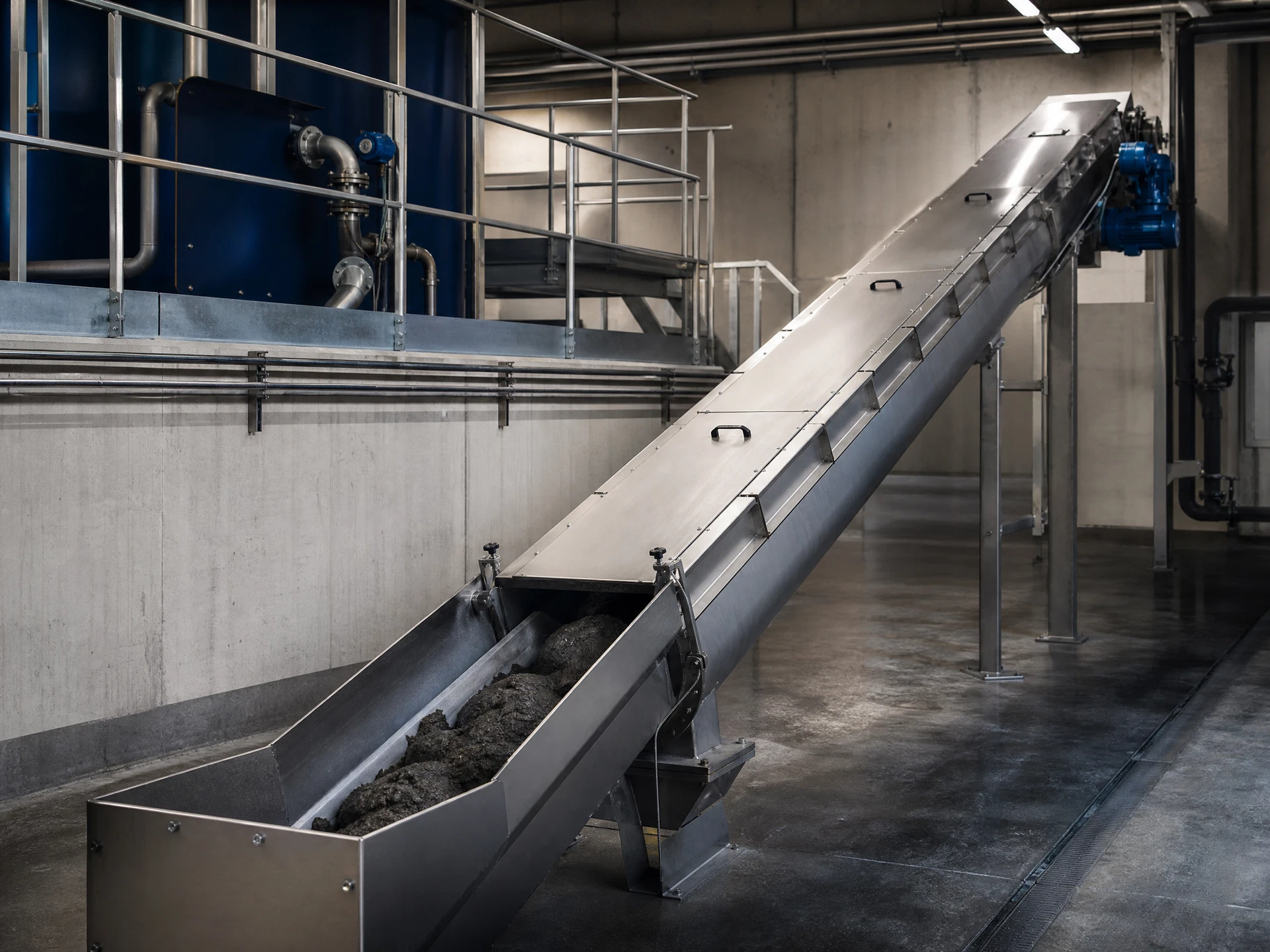
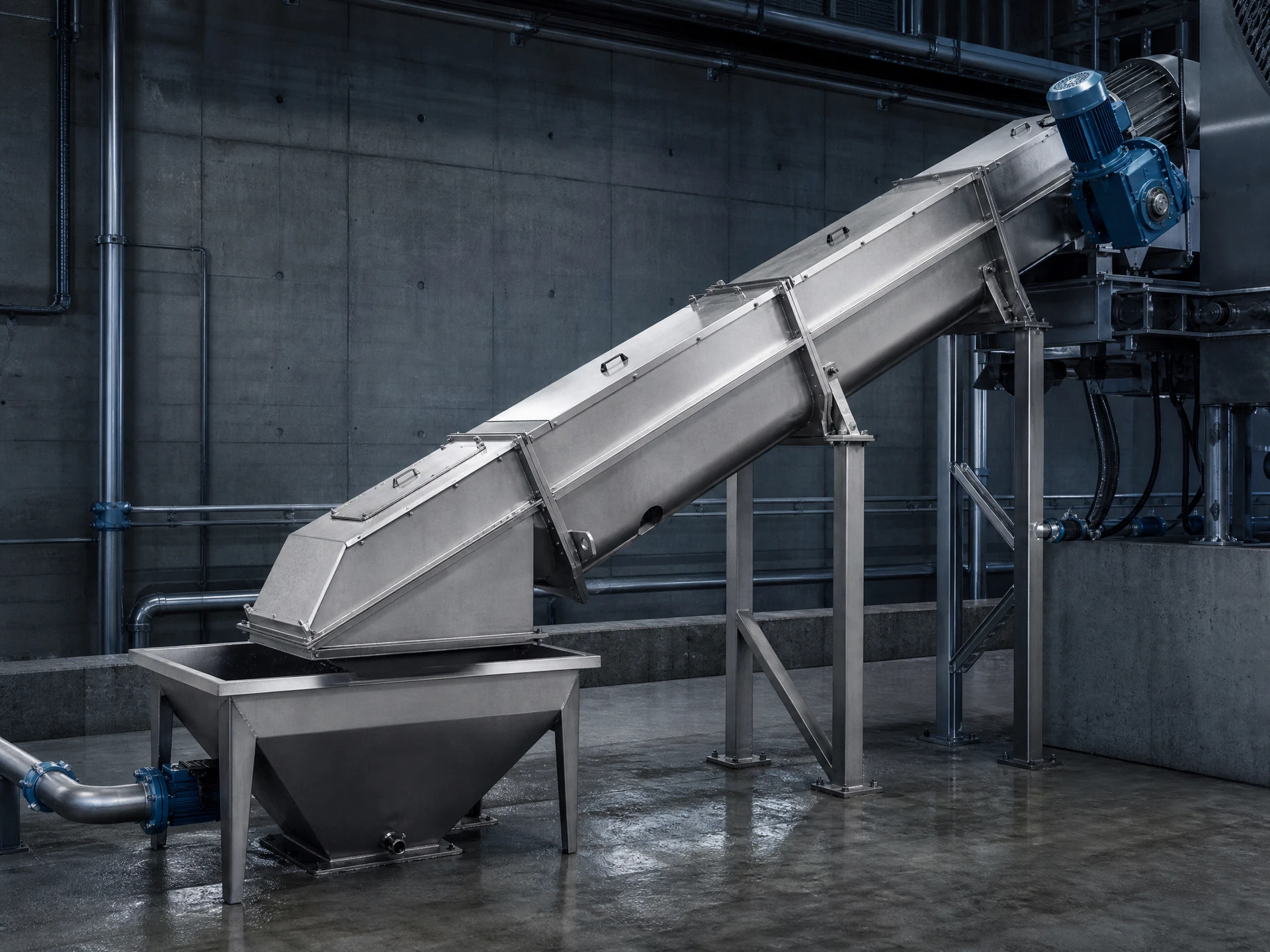
Shaftless screw conveying closes the gap between a solids-separation process and the place where separated material is stored, loaded or processed further. It is particularly relevant when the material is sticky, wet, fibrous or prone to wrapping, because the equipment avoids a central shaft in the transport zone. In a wastewater plant, its value is not only the movement of material. A contained, controlled transfer route can reduce manual handling, make plant layout more orderly and maintain continuity between dewatering, cake storage and final removal.
Process logic and working principle
The supplied catalogue describes an axis-free screw arrangement with wear-resistant nylon liners, two-way conveying capability and enclosed transport features. Material enters a trough or receiving hopper and is advanced by the rotating shaftless spiral along the liner. The final configuration determines how the conveyor interfaces with a screw press, DAF sludge collection point, screen discharge or storage hopper. Its performance is strongly connected to the solids condition; a wet, cohesive cake will move differently from dry screenings or a fibrous pulp residue, even when the nominal equipment diameter is the same.
Configuration should follow the actual duty
The catalogue lists the LS series from LS100 to LS1250, with nominal screw diameters from 100 to 1,250 mm and theoretical conveying capacities from approximately 1.1 to 380 m³/h according to speed. Those values are a useful starting range, but a final duty must account for the actual material and route. Conveyor length, incline, number of transitions, infeed consistency, fill rate, discharge height and enclosure arrangement should be agreed in a layout review. The final drive, liner, trough form and access covers should be selected for the real operating environment.
A disciplined route to model selection
A technically useful conveyor request should describe the material: moisture content, bulk density, particle size, fibre length, adhesiveness, temperature, corrosiveness and whether it can bridge at the inlet. The route is equally important: horizontal and inclined lengths, bend locations, elevation change, floor space, feed method and final discharge. Designers should distinguish theoretical capacity from the required reliable capacity under normal and upset conditions. Inclination normally reduces practical throughput and may influence backflow, retention and wear; it must therefore be documented rather than inferred from a general catalogue number.
Connecting the unit to the wider treatment line
The conveyor can receive cake from a screw press, float sludge after a defined collection process, or screenings from a mechanical screen. It may discharge to a sludge hopper, skip, bagging point, storage area or next process stage. Enclosures, inspection covers, local supports and transition chutes must be coordinated so that material does not accumulate at interfaces. The mechanical and electrical design should also consider whether the upstream machine can run while the conveyor is unavailable. Interlocking protects both equipment and helps preserve a clean, predictable solids-handling sequence.
Operating attention and maintenance context
The catalogue’s emphasis on nylon wear liners should be considered alongside the actual abrasive load and maintenance accessibility. Operators should monitor drive load, material build-up, liner condition, discharge behaviour and any leakage at covers or transitions. Long fibrous solids can demand different feed control from short, granular screenings. Closed transport is valuable for housekeeping, but it should not prevent inspection or cleaning. The final operation and maintenance plan needs access points, isolation provisions and a sensible response procedure for blockage or overload conditions.
How performance should be validated
The published 1.1–380 m³/h theoretical range is not a promise that any material will convey at any angle in every layout. The final capacity should be adjusted for speed, fill factor, inclination, material density, moisture, adhesion and route geometry, then verified in the agreed project engineering. Material-contact construction details beyond the catalogue’s stated nylon liner feature should be confirmed for the wastewater chemistry and corrosion environment. This transparent approach lets the equipment be specified against an actual duty rather than a broad market label.
A practical engineering review before RFQ
A technically complete request for shaftless conveyor equipment should combine process data, mechanical layout data and operating expectations. Process data explains the material or water to be handled; layout data identifies access, elevation, utilities and interfaces; operating expectations identify automation level, service approach and the desired response to an upset. This information allows an equipment proposal to move from a nominal catalogue comparison to a configuration that can be reviewed by the project engineer. It is also the right point to identify what remains to be confirmed through sampling, site survey or a technical clarification. Where several products are supplied together, the package should define responsibility for every hand-off, including feed, dosing, drainage, discharge and control signals. The goal is not to make a proposal needlessly complex. It is to make the scope visible enough that the final equipment can be installed, started and maintained with the intended process role intact.
Installation planning and physical interfaces
An equipment proposal is only complete when the physical installation is understood as well as the process duty. The project team should check the receiving floor or channel arrangement, lifting access, maintenance clearance, feed and discharge elevations, drainage paths, utility connections, local isolators and the route by which components reach the final location. Shaftless Conveyor equipment must also be considered in relation to the machines before and after it. A carefully selected unit can still be difficult to operate if a transition chute blocks, a service door cannot open, a wash-water line is inaccessible or the downstream transfer path has no capacity. General arrangement drawings and interface schedules should therefore be reviewed early, particularly for retrofit sites. The intended sequence for transport, placement, installation, testing and commissioning should be coordinated with the plant programme. Any site responsibilities that remain outside the equipment scope should be stated explicitly so the installation plan does not depend on assumptions made by different contractors.
Controls, alarms and normal operating decisions
Automation is valuable when it makes the equipment state visible and establishes a predictable response to normal variations. The final control package should identify the relevant local controls, field signals, alarms, interlocks and connections to the plant control system. For example, a material feed condition, a low level, a high level, motor overload, poor downstream availability or a utility interruption may each require a different response. The correct logic cannot be standardized without reference to the project, because the risk of stopping a machine depends on the process around it. During technical clarification, discuss the electrical supply, desired local and remote modes, operator interface language, required feedback signals, emergency-stop philosophy, alarm reporting and responsibilities for any plant-level PLC integration. A concise cause-and-effect schedule makes these expectations readable. It also helps commissioning teams test the intended safeguards in a controlled way rather than discovering control gaps after the equipment enters service.
Operating continuity and lifecycle attention
Equipment value is achieved over the operating period, not only on the delivery date. The project specification should consider routine inspection access, cleaning provisions, normal wear parts, safe isolation, spare-parts planning and the practical skills available at the site. The relevant inspection points differ by product, but the operating principle is consistent: observe the unit while it is stable, establish normal operating indicators, and investigate meaningful changes in sound, vibration, load, leakage, material behaviour or outlet condition. A plant that records these observations can plan maintenance before a minor change affects the wider treatment line. This does not require a claim that the equipment will run without attention; it requires a realistic service strategy. When evaluating alternatives, compare the total operating arrangement, including access and interface design, rather than comparing a single catalogue power figure or an unsupported generic maintenance statement. The project documentation should specify exactly which recommended spares, manuals and support arrangements apply to the ordered configuration.
Responsible use of catalogue information
Catalogue data is essential for early screening because it allows project teams to identify families, approximate size ranges and expected configuration questions. It is not a replacement for the final design basis. The values displayed on this page are therefore presented with their source context: where the supplied catalogue states a range, the range is shown; where the catalogue does not state a universal value, the website says that the point must be confirmed. This protects decision quality and avoids creating a misleading appearance of precision. Before issuing a purchase order, the buyer should make sure that the approved proposal records the selected model, capacity basis, utility requirements, materials, dimensions, interfaces, control scope, documents and performance-validation method. That record becomes the reliable source for procurement, installation and acceptance. It is the difference between a useful product page and an unsupported promise.
Document control, scope clarity and responsible claims
Industrial wastewater equipment is evaluated against operating consequences, not only headline dimensions. For that reason, the most useful commercial documents state the supplied equipment boundary, the selected model, the utilities required, the interfaces excluded or included, the controls offered and the assumptions behind any capacity statement. Shaftless Conveyor proposals should separate brochure reference data from project-confirmed design values. They should also identify which parameters are to be checked after review of wastewater or solids data. This approach protects the buyer and supplier alike: it makes it easier to compare alternatives, it prevents a reference range from being mistaken for a universal guarantee and it establishes a clear agenda for technical clarification. Once the final inputs are agreed, drawings, electrical information and operating guidance can be aligned with the actual job rather than with an assumed generic installation.
From enquiry to an informed technical proposal
The next step is an RFQ that describes the site in engineering terms. Include the country and industry, expected operating schedule, project stage, flow or solids quantity, major pollutants or material characteristics, target outcome and any known utility constraints. Photographs, layout sketches and laboratory information can help a technical team identify the most relevant questions quickly. Shandong Shengmai Environmental Protection Technology Co., Ltd can use that information to structure a product discussion around the supplied catalogue range and the intended process interface. Before purchase, the final technical specification should record the assumptions that matter most: capacity basis, materials, instrumentation, electrical supply, installation limitations, documentation, commissioning support and the performance-verification method. That disciplined sequence gives every page of this website a practical purpose: helping an international project team collect the facts needed for a credible equipment decision.